Georgia Forestry Magazine
  • Current Issue
  • Stories
  • Advertising
  • About
    • Contributors >
      • Writers
      • Photographers
  • Current Issue
  • Stories
  • Advertising
  • About
    • Contributors >
      • Writers
      • Photographers
Search by typing & pressing enter

YOUR CART

Adding Value to Family Farms


How OutdoorRecreation BenefitsLandowners andCommunities​

Winter 2024

By John Casey
​
Pictured: One of the many striking views ofthe forests, fields and ponds thatform the alluring Oxford FamilyTrust Farm in Culloden, GA
Picture
Nestled in the heart of Culloden, GA, the Oxford Family Trust’s sprawling 3,000-acre forestry property is a place where the whispers of pine trees, the shimmering allure of ponds and the wide-open fields create a natural tapestry of beauty.

In the family since the 1780s, this land has been the backdrop to cherished memories for generations — an incomparable sight that Mike Harrell, one of the family farm’s business organizers, hopes to share with family members for years to come.

“One of the things I’ve been tasked with is how do we generate interest in the property for the younger generations that don’t remember it as well as the older generations,” said Harrell. “We want to make sure that generationally there’s that love of the property.”

As the family has expanded over the years, so have the challenges. Family gatherings are now filling up the houses on the property to occupancy. So, the question emerged: how can we grow this space and our experience for this family
so that they are inspired to love the land in the same way that we have for years? And then it dinged — why stop at family?

Providing Learning Experiences in Nature

Harrell, passionate for the industry that he’s known his entire life, saw an opportunity: generate additional revenue to
help build up the property to sustain it for future generations while simultaneously extending the outdoor experience to those that otherwise may never know it. Recalling his time participating in the Advancing Georgia’s Leaders in Agriculture and Forestry program, Harrell felt a calling.

“One of the things that stood out to me as I went through the program was that people want to get out in nature and
they are desperate for it. Parents want to provide learning experiences for their children,” said Harrell. “I’ve been a forester my entire life. It dawned on me one day that I need to be involved if I want to continue my career, and not just my career but the industry itself. If this can be a tool to promote forestry and agriculture, I want to promote it.”

From there, Harrell approached his family with the idea to begin leasing the property for day and overnight outdoor
recreational activities. At first it was met with uncertainty, so they landed on a test run to try it out.

“We decided just to dip our toe in. It’s very easy within our family business to make money growing and cutting timber,
and we didn’t want to change the look of the farm. The family likes the open spaces, the open pastures,” said Harrell.

“Over two years of trial and error, without spending a lot of money, we just wanted to try it out and see if there’s even an interest in this.”

Activating the Land While Keeping it in Trees

The test was a resounding success. The small town of Culloden, with a population of only 200 people in rural Central
Georgia, was already surrounded by short-term rentals, but very few offered the range of activities and experiences
that could be found on the sprawling acreage of the Oxford family’s farm. Best of all, it could all be done with minimal
impact on regular forestry operations.

“What we strive to do is a farm vacation Airbnb feel. You can go to the pond and fish, bring your mountain bikes and ride around, or just watch the sunset. Any kind of unplugged activity is what we strive for,” said Harrell. “And 100% of
the farm remains managed forestland.

Some is maintained forest, where we are just keeping it healthy and looking how we want. Some is intensively managed forests, but you’d never see it. If you were to drive around the property, you’d wonder where we’re even cutting timber.”

Harrell admits there were many questions and challenges over the test run, but thankfully, one company is coming ontothe scene with a product that is helping to streamline the process for private landowners looking to lease their property for outdoor recreation.

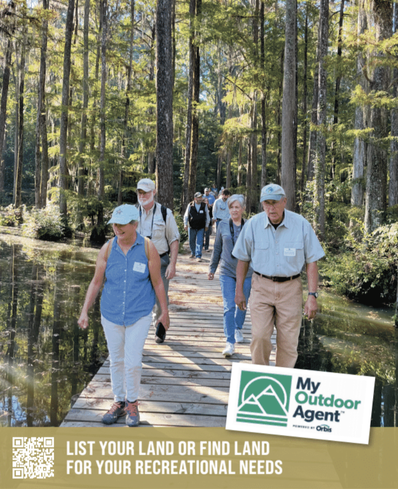
Kim Kean, director of marketing at Orbis, Inc., compares their innovative app My Outdoor Agent to the well-known short-term rental models of Airbnb and Vrbo, but with much broader uses that enable property owners to activate their land for a wide range of outdoor recreational activities.

“Users can go into a portal, narrow down an area you want to visit, and check the specifications of their needs. On the property owner end, they set the terms, availability, and manage payment. It’s a similar concept to Airbnb, but with much more to offer,” said Kean.

According to Kean, most forest landowners lean on hunting leases to produce additional income, often locking up their
property to one or a few individuals each year. With My Outdoor Agent, landowners can still provide hunting leases, but also open the property up to other activities that broaden their income possibilities.

“My Outdoor Agent gives the flexibility to do it in time spans ranging from a weekend to a full season to even a full
year if you want it to be,” said Kean. “That way, when it’s not hunting season, you can invite birdwatchers, campers, fishers, hikers and more to experience your property. The sky is really the limit.”

All hunting seasons combined in the state of Georgia account for less than six months out of the year, leaving over half
of potential outdoor recreational income unaccounted for in the traditional hunting lease model — but now, everything is on the table.

“For those who have been doing traditional hunting leases, it’s an opportunity to break away from stagnant rates that have often been held for decades. It’s limiting their potential profit, but more importantly it’s cutting off your land to
folks who could be using it and learning about the importance of getting out in nature,” said Kean.

And that’s where the passions of Mike Harrell, Kim Kean and Orbis, Inc. really come together — a mission to drive exposure and education on the outdoors, agriculture and forestry.

Educating the Public to Keep Forests as Forests

“As development grows, outdoor spaces become more and more limited. Then factor in how much of the land is privately owned, and you realize it’s a very restricted space that the everyday person is struggling to find access to,” said Kean.

“The awareness in urban pockets is so minimal of outdoor spaces, not just in terms of recreation but also education.”
To connect and educate Georgians on the importance of working forests, the Georgia Forestry Foundation (GFF) partnered with Orbis and Birds Georgia to launch Georgia Bird Bookings — a program that allows private landowners to lease their property to birdwatchers.

According to Clarence Neese, co-founder and vice president at Orbis, Inc., the effort is critical to exposing the public to agriculture and forestry, while also putting some extra money in the pockets of the state’s stewards of natural lands — foresters and farmers.

“The intent was to help educate the public, particularly those from urban  areas like Atlanta, about the importance of our forests, farms and natural lands.

By allowing people to explore maintained private forests, it gives people who would otherwise never have exposure to forestry an understanding of how certain harvesting or other working forestry practices are improving the quality of our natural lands,” said Neese. “It’s not solely a revenue thing, though it will definitely help make landowners money. It’s also about the impact that they can have by exposing more people to outdoor recreation than just letting five hunters come on your property.”

In the face of evolving times, with economic conditions and urban sprawl putting pressure on large landowners, Neese believes that it’s critical to utilize all the available revenue streams at their fingertips. A study from the U.S. Fish and Wildlife Service reports that in 2016, wildlife-watching enthusiasts generated $75.9 billion in revenue. With more and more people picking up outdoor hobbies over the last few years, that number has likely increased.

Georgia Bird Bookings connects landowners to a growing revenue opportunity for their land, while providing GFF the opportunity to educate birdwatchers about how managed forests provide a wide range of forested habitats at different management stages across a given landscape. For instance, streamside buffers that are left to protect water quality provide great habitat for Swallow-tailed Kites and Hooded Warblers. Mixed forest stands also provide habitat for Pileated Woodpeckers, Red-shouldered Hawks and Barred Owls. And a regenerating young forest is important for the Prairie Warbler and Northern Bobwhite.

“Ultimately, the economic return from this program provides a way to recognize landowners for their investments in stewardship while helping to keep forests as forests.” — Nick DiLuzio, VP, Georgia Forestry Foundation
“We are excited about this unique partnership that will give birders an opportunity to see species that they may not
have seen on public lands,” said Nick DiLuzio, vice president of the Georgia Forestry Foundation. “Ultimately, the
economic return from this program provides a way to recognize landowners for their investments in stewardship while helping to keep forests as forests.”

The impact that this additional revenue can have on family farms across the state cannot be overstated. In the case of Harrell and the Oxford family, it could be the extra dollars needed to build up housing amenities for their family. For others, it could be the extra dollars needed to fund new equipment, new land, or offset property tax increases due to urban sprawl and inflation.

Most importantly, efforts like these can have a lasting impact on the familyfarm industry for years to come — bringing newfound passion for the industry to those who may never have the opportunity to experience it otherwise, while also bringing support to farmers and foresters across the state.

“I’m a big fan of family farms and the people who operate them. They’re jewels in the state of Georgia. I guarantee you can go talk to any of them and they’ll be so proud.

They want to show you their property and the legacy they’re trying to provide for,” said Harrell. “I wish more of those properties could be showcased, because you would see how much work these families put into the land. They celebrate the uniquities of their properties, a celebration that I hope everyone can one day take part in.” ■

John Casey is a strategic communications professional who supports clients through the art of storytelling. In his downtime, John can be found hunting and fishing on his family’s centennial farm in Northwest Georgia.
Georgia Forestry Magazine is published by HL Strategy, an integrated marketing and communications firm focused on our nation's biggest challenges and opportunities. Learn more at hlstrategy.com
Picture