Georgia Forestry Magazine
  • Current Issue
  • Stories
  • Advertising
  • About
    • Contributors >
      • Writers
      • Photographers
  • Current Issue
  • Stories
  • Advertising
  • About
    • Contributors >
      • Writers
      • Photographers
Search by typing & pressing enter

YOUR CART


Fueling Biomass Growth in Georgia


How GFC Calculations Impact Industry Attention
​​​​​
By Stasia Kelly

​Spring 2023

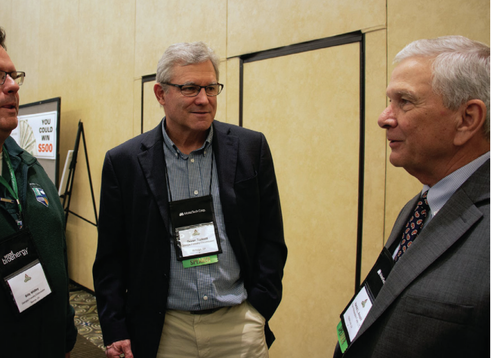
PictureThe GFC’s Billy Whitley and Devon Dartnell talk biomass with Fram Renewable Fuels President Harold Arnold.
Georgia’s emerging biomass industry is dependent on numerous support mechanisms. While some are visible in the public spotlight, others provide essential development resources behind the scenes. One of these critical players is the Georgia Forestry Commission’s (GFC) Services, Utilization, and Marketing (SUM) Department.

The GFC’s SUM group is widely considered the “go-to” team for a current read on Georgia’s forest resources. A number of programs are conducted annually that quantify information about the amount of timber growth and removals, mill activities, and other factors that impact forest supplies and usage. A tremendous amount of corresponding data is gathered and collated as needed for prospective forest businesses considering Georgia in their future plans.

​As a state agency, the GFC equally supports all forest products sectors, with a goal of maintaining and increasing value for Georgia timberland, mills and forest products. Biomass facilities are just one part of the equation as the GFC and its partners continue their mission to “Keep working forests as forests.”

Biomass Questions? We’ve Got Answers
“We work with new industry — which includes people looking to put biomass facilities in Georgia,” said GFC SUM Forester Dru Preston. “State and local economic development agencies and municipal leaders, as well as interested companies, come to us, and we provide the data resources. Those facts can be used to prove whether sustainable biomass supplies can support a startup business.”

The backbone of resource information supplied to interested parties is Forest Inventory & Analysis (FIA) data. In conjunction with the US Forest Service, GFC foresters routinely survey a series of permanent sample plots in order to assess current forest resource status and trends. Data is gathered from randomly placed research plots that statistically represent about 6,000 acres.

FIA measurements quantify a number of important factors, including species composition and condition, wood growth and removals, live wood and biomass volumes, forest health, and land use changes. The collected data is electronically collated at the US Forest Service’s FIA center in Knoxville, TN. Based on a five-year rolling average, the information is compiled into county, regional and state summaries, which are made publicly available and are highly valued by the state’s private sector forest industry, forestry consultants and academic researchers. A geographic wood-basket study area typically includes at least a 50-mile radius up to a 100-mile radius of a given point. “From the data we provide, including historical data, forestry consultants can run their own models,” said Preston. “They can then make their own evaluations and projections so that their clients can make the best and most informed decision on site selection.”

GFC SUM Specialists Billy Whitley and Jonathan Brown provide timely and relevant information for the biomass industry as well as all other Georgia wood-using industries. Their team also provides technical and educational information to the rest of the forestry value chain, which ranges from forest landowners to forestry contractors and consultants. The SUM department’s work is truly a team eff ort, with each member adding their own expertise, value and unique talents.

The GFC pushes information out to stakeholders as it fulfills its mission to educate Georgians about the state’s forest resources. Presentations are regularly given to landowner groups, legislators, academia, municipal entities and the media. The Commission also staff s a number of relevant tradeshows and conferences, including the mammoth International Woodworking Show held bi-annually in Atlanta. A variety of GFC-produced publications support Georgia’s timber-ready messaging, including a Biomass Suppliers Directory that off ers information on potential synergies that might be developed with local forest industry businesses and landowners. A wide variety of reports and documents are available on GFC’s public website at gatrees.org/forest-industry.
Picture
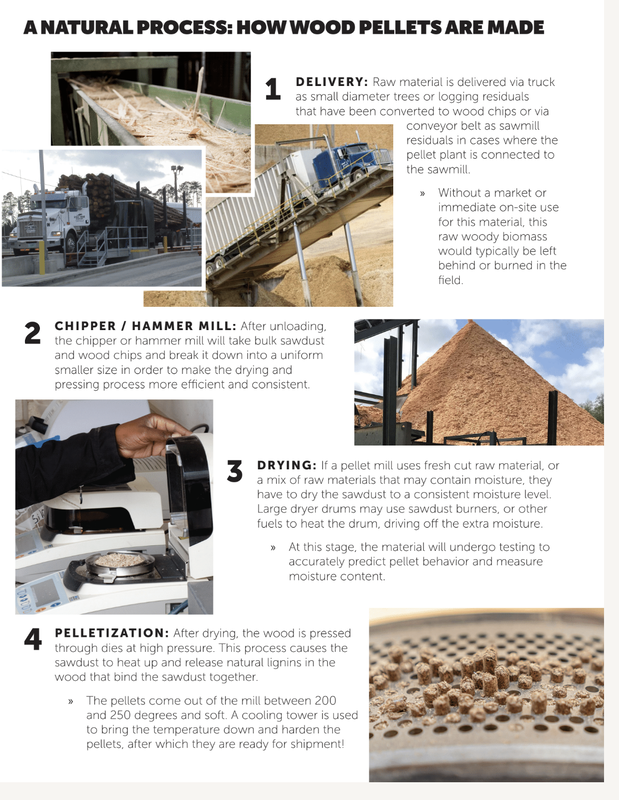
The GFC has supported existing and startup industries that utilize wood biomass to generate electricity, produce wood pellets and refine biofuels. “We assist in identifying appropriate sites with ample feedstock supplies and infrastructure,” said GFC SUM Chief Devon Dartnell. “We help startup forest biomass industries with resource and supplier information as well as assistance in obtaining federal grant funding to help cover research and capital expenditure costs.”

Dartnell said an exciting example is the recently announced award of US Department of Energy funding to AVAPCO, LLC in Thomaston, GA. (See page 5 for more details.) The GFC has been supporting AVAPCO, LLC with technical and feedstock support for many years.

The Commission calculates that more than 9 million tons (oven-dry basis) of unutilized forestry biomass could be captured by the bioenergy industry each year. Over the past 15 years, that excess has fueled a growing wood-pellet industry. The agency has been instrumental, along with the Georgia Department of Economic Development and local developmental authorities, in providing assistance to potential wood pellet investors and the biomass electricity industry, enabling them to locate in the state.

“In 2007, there were no pellet mills operating in Georgia,” Dartnell said. “Today there are eight! The vast majority of pellets manufactured here are exported to Europe for electrical energy and heat production.”
Picture
​Georgia Delivers the Goods

The Port of Savannah is the busiest wood-pellet export port in the world. According to the Georgia Ports Authority, Georgia exported 1.76 million metric tons of wood pellets in 2021, worth $300 million. The Russian invasion of Ukraine has interrupted energy supplies throughout Europe, potentially increasing demand for wood pellets from the US. Georgia produces an additional 20,000 tons of wood pellets for domestic heating and cooking, valued at $32 million annually.

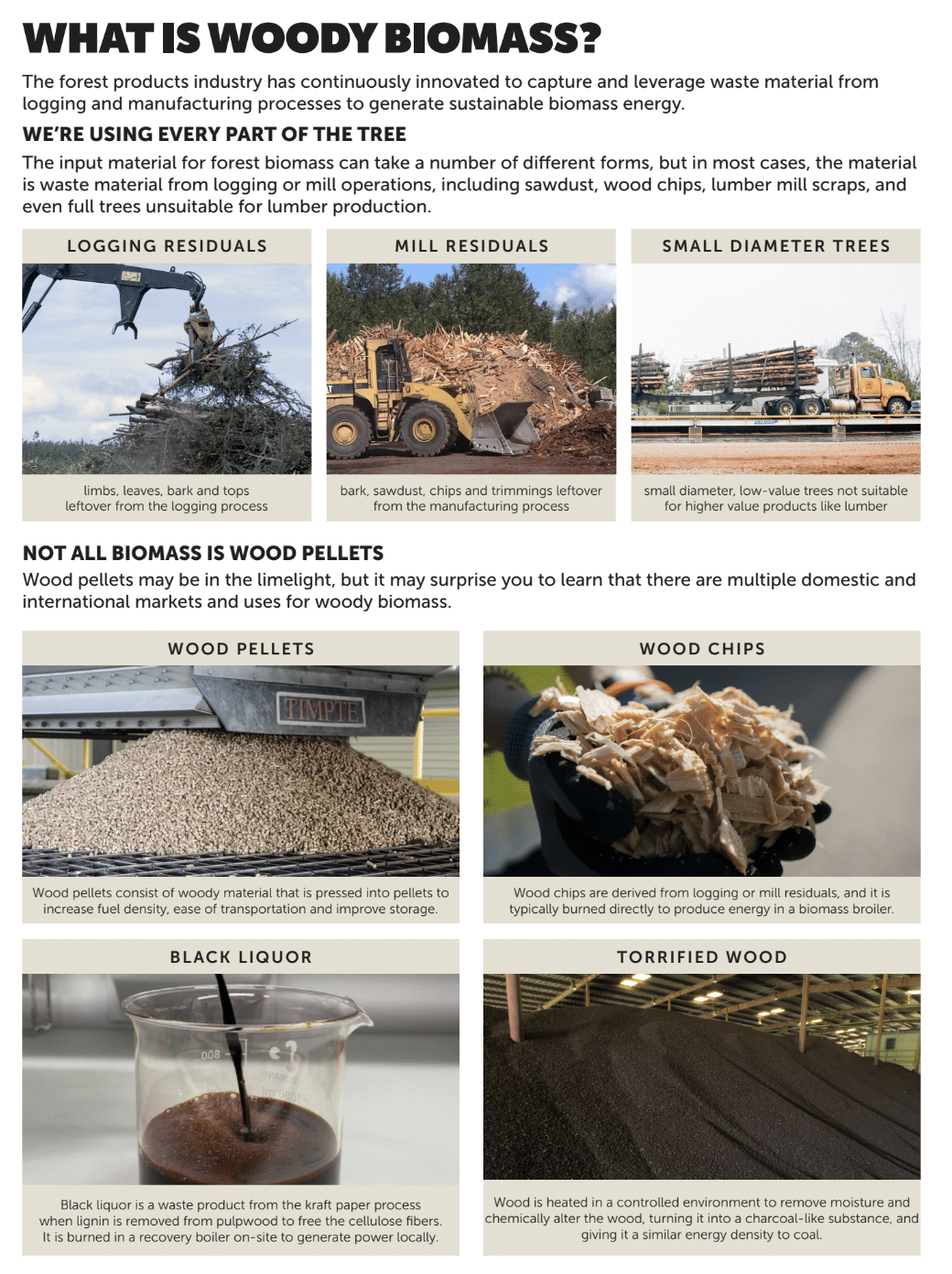
​As the #1 forestry state in the nation, Georgia is uniquely positioned to supply the demand for biomass for wood pellets, electricity and biofuels. The state’s industry seeks to maximize use of the resource, and the demand for biomass has proved valuable for landowners seeking markets for their small diameter and cull trees and tops and branches of harvested trees. Rural economies have benefited from wood pellet mills through job creation, tax revenues and the multiplier effects that a new industry brings. Even urban wood waste has become part of the mix that fuels this sustainable fiber “recycling” process.

According to the US Energy Information Administration (EIA), 5% of Georgia’s own electricity resource mix comes from biomass — mostly wood and wood-derived fuels. These accounted for nearly half of the state’s total renewable electricity generation in 2020. The EIA reported the state generated 5 million MWh of electricity from biomass, or 10% of the nation’s biomass-fi red total net generation. That’s more than any state except California.

The GFC was instrumental in providing custom reports about forest resource availability to investors building a biomass-powered facility in Barnesville, GA. Launched in 2013, Piedmont Green Power owns the 55 MW facility, which annually utilizes approximately 500,000 tons of woody biomass, consisting of urban wood waste along with mill and logging residue. Piedmont Green Power services Georgia Power.

Another project taking shape in Adel, GA is Spectrum Energy’s wood-pellet manufacturing facility. A particleboard facility that closed in 2014 is being repurposed for the pellet plant, which created concern from local residents who argued community air quality would be affected by its operation. Following a somewhat contentious struggle centering on air quality permits and industry development patterns, an agreement was reached. Spectrum submitted to increased pollution control limits that exceed GA Environmental Protection Division requirements and additional “good neighbor” provisions to increase transparency in the community. The plant is expected to be fully operational by the fourth quarter of 2023.

As the forest industry continues to seek and develop new markets for Georgia timber, the GFC is embracing leading edge technology and the latest science to enhance its services. Supporting a growing biomass market that benefits Georgia is key to those goals. “It’s exciting to see how small-diameter trees and wood waste products can support a renewable source of energy,” said GFC Director Tim Lowrimore. “As the Commission, we look forward to continuing to play a critical role for Georgia’s economy, the environment, and especially our forest landowners.” ■


STASIA KELLY IS A MEDIA RELATIONS SPECIALIST WITH THE GEORGIA FORESTRY COMMISSION. STASIA IS FOCUSED ON TELLING THE STORY OF FORESTRY AND THE IMMENSE IMPACT OF THE INDUSTRY ON GEORGIA’S ENVIRONMENT, ECONOMY AND HERITAGE.
Georgia Forestry Magazine is published by HL Strategy, an integrated marketing and communications firm focused on our nation's biggest challenges and opportunities. Learn more at hlstrategy.com
Picture